By Edith Hathaway © 2026
“The cause of America is, in a great measure, the cause of all mankind. Many circumstances have, and will arise, which are not local, but universal; and through which the principles of all lovers of mankind are affected, and in the event of which, their affections are interested.”
Thomas Paine, Common Sense, Philadelphia, Jan. 10, 1776
The American Declaration of Independence (July 4, 1776) contains a long list of grievances against the British Crown. Tensions had been escalating since the early 1760s, especially with British seizures of American colonists’ ships and sloops. It all began soon after the French and Indian Wars (May 1754 to Oct. 1763), which the British won. But the wars had so drained the British treasury that there was now an urgent need to raise funds. So they decided to tax the American colonists. British Parliament passed The Revenue Act of 1767 and The Townshend Acts in 1768. They demanded greater imperial control through import duties and stricter customs enforcement. But this only increased colonial resistance and inflamed the colonists, who were the most literate people in the world, with men at a 90 to 95% literacy rate and women at 80 to 85%, especially in New England, where the earliest protests against the British most often occurred. They were religious people for whom the Christian Bible was the foundation to their education. There was a deep focus on the nature of freedom, and whether one’s first obligation was to God or the King. Many settlers came to America seeking freedom of religion and freedom of speech.
Prior to this was The Stamp Act of 1765, taxing paper goods. It had caused massive protests, riots, and boycotts and was the first major imperial crisis. The Stamp Act was repealed in 1766. When John Hancock’s ship Liberty was seized in Boston Harbor on June 10, 1768, this caused a firestorm, major riots in Boston (the Liberty Riots), and another early flashpoint in the growing conflict between colonists and British authorities. Hancock was the wealthiest merchant in all of New England and he was accused of smuggling Madeira wine. After the Liberty Riots and by Oct. 1, 1768 larger British troop reinforcements were sent to occupy Boston.
Within a few years further tensions between colonists and British troops stationed in Boston led to yet more acts of rebellion. On March 5, 1770 British soldiers fired on a crowd, killing 5 colonists. It was dubbed “the Boston Massacre.” Then on Dec. 16, 1773, colonists destroyed 342 chests of tea in Boston Harbor in protest of the Tea Act of May 1773 and continuation of the Townshend Acts of 1768. Colonists were angry over “no taxation without representation.” This was dubbed “the Boston Tea Party.”
Two years later came the Battle of Lexington and Concord on April 19, 1775 and this is usually considered the official start of The American Revolutionary War. It was the first organized regional uprising. Ralph Waldo Emerson wrote about it in his poem “Concord Hymn,” 1837: “Here once the embattled farmers stood / And fired the shot heard round the world.”
Starting in the middle of the night, British soldiers marched from Boston to Concord, reaching Lexington just before dawn. Their assignment was to capture and destroy colonial munitions stored in Concord. But they were foiled in their mission, and ended up suffering nearly three times as many casualties as the American colonists, especially in their retreat back to Boston. Initially they had outnumbered colonial militia on Lexington Green by 10 to 1, but by midday about 4,000 New England militia were engaged from surrounding towns — having been warned by Paul Revere, William Dawes or Samuel Prescott, who were the first link in a much larger chain of dozens of riders. This enabled the largest spontaneous military mobilization in American history up to that point.
Another important turning point was the publication of Thomas Paine’s 50-page pamphlet Common Sense on Jan. 10, 1776. In it he argued very cogently for the need to break free from unreasonable civilizational and political restraints. Thomas Paine (1737-1809) was a British political philosopher who had only arrived in the American colonies as of Nov. 30, 1774. (Ben Franklin met him in London, suggested he should come to America and set him up with some important contacts.) Paine’s pamphlet sold more than 500,000 copies within a few months. More than any other single publication, it laid the groundwork for the American Declaration of Independence, signed just six months later on July 4, 1776. . This pamphlet was read widely in homes and taverns throughout the colonies and was extremely effective in persuading the colonists that revolution was necessary in this instance.
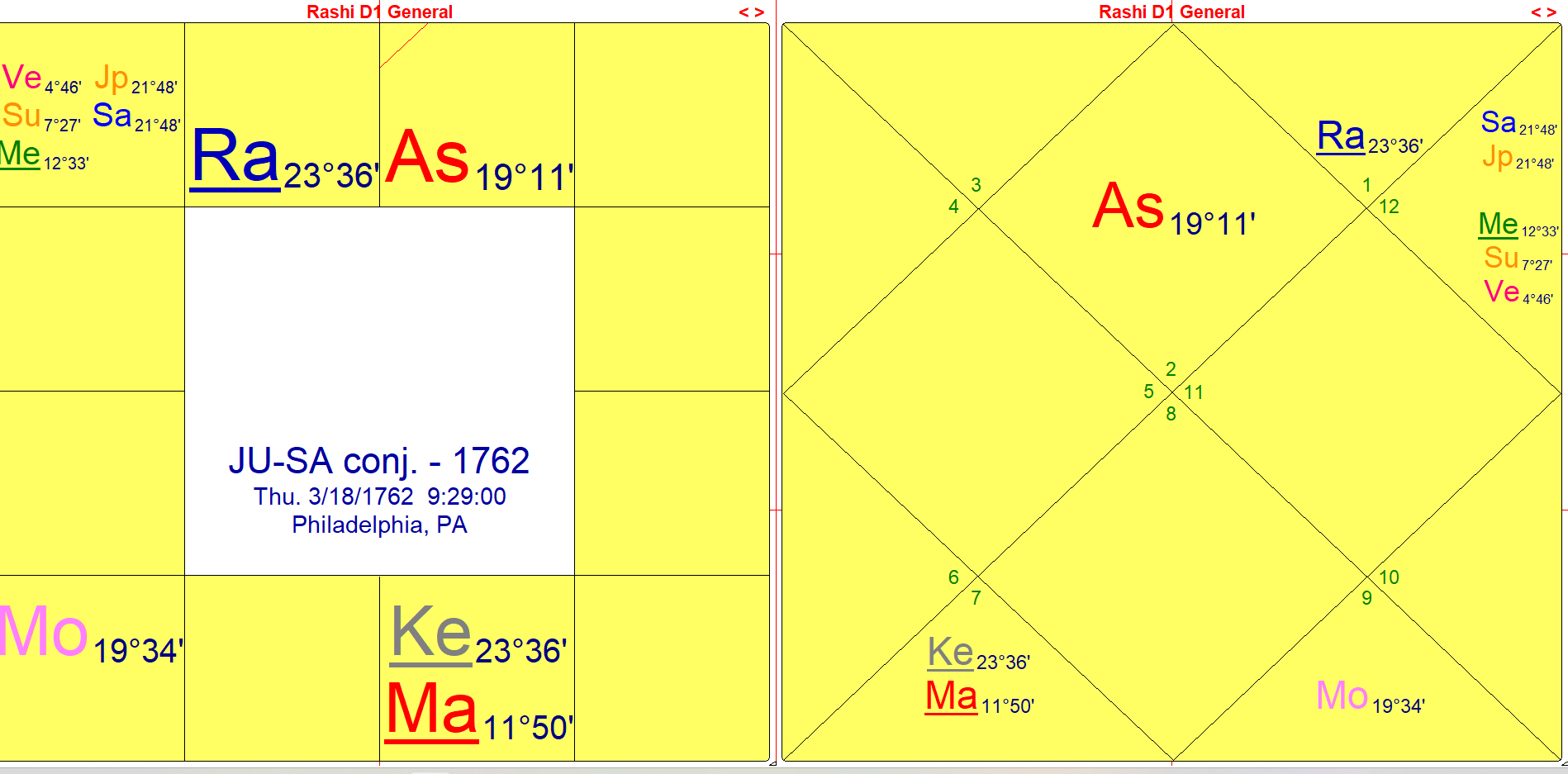
How to read a North and South Indian chart. All planets are in the sidereal zodiac (Lahiri ayanamsha). Underlined planets are retrograde.
As we can see, most of the birth process of the new nation of the United States took place between 1762 and 1782. The first serious conflict between the colonists and the British was the Royal Proclamation of 1763. Issued by King George III on Oct. 7, 1763, it forbade American colonists from settling or exploring west of the Appalachian Mountains. Colonists already in those western areas were ordered to withdraw. This Proclamation angered colonists, though another treaty in 1768 (Treaty of Fort Stanwix) moved the boundary hundreds of miles further west to the Ohio River.
After eight years of warfare (1775 to 1783) the final resolution of the American Revolutionary War came in stages, initially with the Preliminary Peace Agreement on Nov. 30, 1782, just 25 days after the exact JU-SA conjunction of 1782, then with the King’s Royal Proclamation of the Cessation of Hostilities on Feb. 14, 1783, and in the end with the Treaty of Paris on Sept. 3, 1783.
We will discuss the larger JU-SA conjunction cycles shortly, but first it is important to understand that these cycles set up the momentum for the major themes of the upcoming 20 years. The JU-SA conjunctions occur every 20 years and describe the socio-economic-political themes of that era. They occur in one of the four elements (FIRE, EARTH, AIR or WATER), in that order, for 100s of years before mutating into the next element. The very last of the JU-SA conjunctions in WATER was in 1762, after WATER had dominated for 298 years (1425 to 1723). The WATER to FIRE Mutation period ran from 1702 to 1782, using the sidereal zodiac/Lahiri ayanamsha throughout.
The JU-SA conjunction chart of 1762 reflects the exceptional drama that would occur in the next 20 years involving the American story, specifically the transition of 13 mostly obedient British colonies into a single unified nation-state in its own right. Most of this happened between 1762 and 1782, as noted, when American colonists were pushed by increasing acts of British tyranny into realizing that they had a right to govern themselves, apart from the dictates of the British government. They had the revolutionary idea for that time and for all times – that their right to life, liberty, and the pursuit of happiness came from God and not from the King or from any government. No other national constitution was ever founded on these principles.
The first major event in the American Revolution following the JU-SA conjunction of 1762 in Pisces was 19 months later. Major events after the 1782 JU-SA conjunction in FIRE (Sagittarius) moved more quickly. The initial British-American Peace proposal was just 25 days later.
The JU-SA conjunction of 1762 is in Pisces – a sign of surrender and devotion, though devotion to God, the Creator is considered the highest level of surrender, which is why Venus is exalted in watery Pisces. In mundane astrology, the WATER element is connected to religion and royalty. Pisces is a sign of Moksha (spiritual liberation) and rules over the classic 12th house – a Vyayasthana – meaning a house of loss and expenditure; also the highest level of the Moksha houses, ruling over spiritual growth and liberation. Moksha houses are also associated with some degree of personal suffering and loss, especially including financial loss and expenditure.
Governed by Jupiter, planet of Dharma, a Pisces emphasis denotes having to give everything towards a singular cause. Often a deep level of sacrifice is involved. But if enough devotion is present, so also is Divine Providence. Many historians believe that the birth of this country would not have happened without Divine Providence, with so many inexplicable turn of events, notably in battle, and with the extraordinary knowledge and wisdom of the Founding Fathers.
The colonists were also fortunate in their alliances, both military and financial. We see this through the strong 11th house of friendships from the Taurus Ascendant. Financial aid came from both the French and the Dutch, with critical military aid from the French, notably at the Battle of Yorktown in Oct. 1781 and a powerful naval blockade. Spain also provided important financial aid, though none of it directly.
Five planets are situated in Pisces in the 1762 conjunction chart: Venus, Sun, Mercury, Jupiter and Saturn, in that order. All classical physical planets are in just three houses/signs and those signs are ruled by either Venus or Jupiter, the two great benefic planets. Venus is exalted in Pisces and Jupiter rules the sign of Pisces (as well as Sagittarius). This gives extra strength to all matters under the realm of Pisces. All planets are also contained within Rahu and Ketu (the eclipse axis) – a Kala Sarpa yoga (Time-Snake yoga), which gives extra intensity. In a chart set for Philadelphia, Rahu-Ketu extends across Houses 6-12. In a chart set for London, UK Rahu-Ketu extends across Houses 2-8, the financial houses, and indeed financial considerations motivated most of the British actions vis-à-vis the American colonies from 1762.
King George III was both married and coronated in Sept. 1761. He had become King at age 22 upon the death of his father on Oct. 25, 1760, and he reigned for 59 years until his own death on Jan. 29, 1820. This 59-year span marked a 2nd Saturn return to Pisces, where it was situated at the 1762 JU-SA conjunction. King George III had an immense impact on the birth of the United States, especially given his long reign, the longest in British history prior to Queen Victoria and Queen Elizabeth II.
There is added extra intensity when all classical physical planets are situated in only three houses: a Sankhya Shoola yoga. Shoola in Sanskrit means “a spear, a spike or thorn.” It gives the essence of “struggling. A person with this yoga usually has the destiny to be a thorn in the side of others, often because their ideas and/or actions challenge the status quo in some way. (See my recent article on Charlie Kirk, who had this yoga.) For King George III, the 13 American colonies became a thorn in his side with their rebelliousness. This yoga already intensifies the earth’s atmosphere by bundling all the classic Vedic physical planets into just three signs of the zodiac. At times earthquakes or volcanic eruptions can result. Inded, the birth of America was an historical earthquake of sorts.
Both Mercury and Mars are retrograde in this chart. There was backtracking on many fronts. Even Ben Franklin, an Anglophile of the first magnitude, found it necessary to switch his allegiance to American independence and against the British. He lived in Europe for 25 years, 18 years in London and 9 years in Paris. Franklin often lobbied on behalf of the colonists with British authorities, but by Jan. 1774 he finally realized they would never treat the colonies fairly. When he defended the Massachusetts colonists for their protest against the Tea Tax he was soundly repudiated in front of the British Parliament. And with that event his hopes for reconciliation died. The Boston Tea Party of Dec. 1773 had infuriated the British, especially the King.
Then came the Battle of Lexington and Concord on April 19, 1775, when the colonials were initially outnumbered 10 to 1 by the British regulars, who fired on local Minute Men at Lexington Green, killing 8 of them and injuring 10. But in the end the British regulars—about 700 at the start and reinforced to roughly 1,700—failed to seize the colonial munitions at Concord, most of which had already been moved. As they retreated toward Boston, they were met by a swelling provincial force of nearly 4,000 militia. They used mobile, irregular tactics along the road, while the British regulars, though highly trained, used European linear warfare, with strict hierarchies and formal tactics. By day’s end the British suffered 273 casualties—73 killed, 174 wounded, and 26 missing—nearly three times the colonists’ 95 casualties, and underscoring how completely the advantage had shifted to the colonial militia.
This day marked the collapse of the British expedition and the opening clash of the Revolutionary War. These stories also reflect Mercury not only retrograde and debilitated in Pisces but corrected by the presence of both Venus and Jupiter in the same sign, becoming all the stronger for it – a Neecha Bhanga Raja yoga. This means that after initial setbacks, notably in communications, victories can be achieved.
Granted, this 1762 JU-SA conjunction chart is a 20-year forecast chart, but some of the most notable themes of the era can be seen in that chart. In the JU-SA 1762 conjunction chart set for London, the five planets in Pisces are in the 7th house of partners and/or open enemies. From the time of the Boston Tea Party in Dec. 1773 King George III saw the protests as an open rebellion that had to be crushed.
The Moon is in Sagittarius, with no planets in adjacent houses, a modified Kema Druma yoga, i.e. Kema Druma Bhanga, since there are planets in an angular house to the Moon. The people are forced to stand up for themselves, but one issue at a time. Sagittarius denotes a yearning for freedom and for nation-building. The practice of slavery was not yet ended in America until 1865, while Great Britain abolished the slave trade in 1807, and in 1833 abolished slavery entirely except on one or two islands. The largest of the slave-trading nations, Britain was the first to abolish slavery. The Founding Fathers would have lost the participation of the Southern colonies if they had tried to include that issue in the Declaration of Independence. So it was not yet addressed in that document.
Six out of nine planets are in Dual signs (Sagittarius and Pisces), evoking the flexibility and changeability of the period, e.g. having to choose sides against the British Crown. (Out of a population of two million, some 20% of colonists were Loyalists, not wishing to separate from Great Britain. After the war, around 100,000 Loyalists were repatriated to Canada, Britain, and the Caribbean.)
Reflecting the JU-SA conjunction in WATER, the British Navy held tremendous superiority from 1762 onward until their combined land and sea forces were defeated in Oct. 1781 at the Battle of Yorktown. They faced combined French and American military forces. (The French-American alliance was official from Feb. 1778, once the Americans defeated the British at the Battle of Saratoga in Oct. 1777.) The French naval blockade was the pivotal factor in the British defeat at Yorktown. Without the French fleet sealing off the Chesapeake Bay, General Cornwallis would have escaped, been reinforced, or been evacuated. Yorktown would not have been the decisive end of the war.
British attacks on American ships were of tremendous significance in fomenting the American revolution, and symbolically, taxes on tea were pivotal apropos the Boston Tea Party. Further, John Hancock’s ship Liberty was carrying another liquid: Madeira wine. Of these two hottest protest items, Madeira wine was the most heavily taxed and subject to the worst abuses by customs officials. As the preferred drink of the Founding Fathers, the heavy luxury tax radicalized the political class: the merchants, lawyers, legislators, and wealthy patriots.
In more general terms, during the WATER period (1425 to 1723), sea voyages were undertaken for the glory of the monarchy, but also in most cases to expand Christendom or Islam. The coronation of George III took place just six months before the 1762 JU-SA conjunction in Pisces. And to a great extent his entire reign was defined by ruling over the American colonies and then subsequently losing them. Of course the British Empire had other holdings, including India, but the American colonies were the largest, wealthiest, and fastest‑growing part of the empire.
The Lead-up to Peace Agreements in 1782-83
One might assume that the last decisive military victory by American militia (fortified by French militia) would shortly clench a final victory in the American war for independence. This occurred at the end of the 3-week long Battle of Yorktown on Oct. 19, 1781 when British General Cornwallis surrendered his army of 7,000 troops to the command of General George Washington. But though it was a military victory it was not yet a political victory. King George III was not yet ready to surrender his most lucrative and prized colonies. Losing the American colonies was a complete humiliation to him, the “dismemberment” of his empire. In addition, Britain still held New York, Charleston, Savannah, Canada, and the world’s strongest Navy. But even if King George was not ready, the British Parliament was divided, with the pro-war Tories eventually losing control.
It was over a year later when the first Preliminary peace agreement was signed on Nov. 30, 1782. This coincided closely with the start of the core FIRE period Nov. 5, 1782 in the larger Jupiter-Saturn conjunction cycle. A few months later came the King’s Royal Proclamation of the Cessation of Hostilities on Feb. 14, 1783. Then on Sept. 3, 1783 the Paris Peace Treaty was signed, formally recognizing the 13 colonies as “free, sovereign, and independent states.” Britain also ceded most of the land east of the Mississippi River. Founding Fathers Benjamin Franklin and John Adams were exceptionally skilled negotiators, and their combined talents led to the achievement of very generous peace terms in 1782-1783.
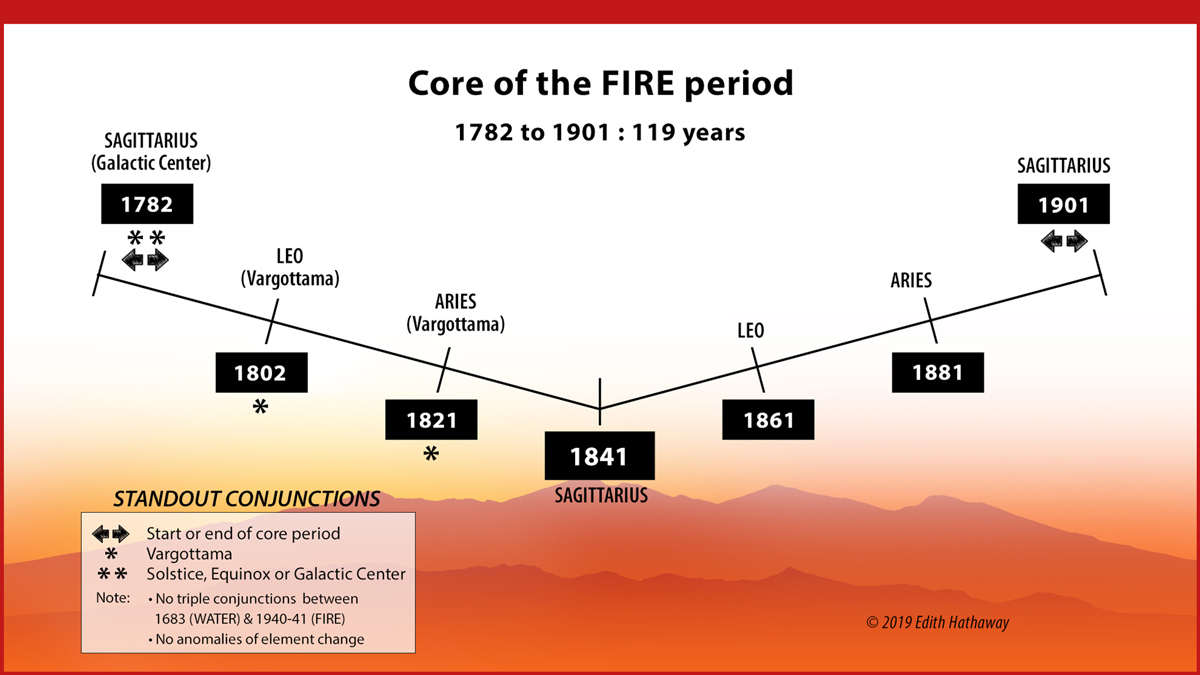
FIRE period >> the birth of stronger nation-states
In astrological terms, the American colonists were unlikely to achieve nationhood definitively until after the first Jupiter-Saturn conjunction in a sidereal FIRE sign, and one marking what I call the core of the FIRE period: Nov. 5, 1782 to Nov. 28, 1901. The larger FIRE dominant period ran from Jan. 5, 1723 to Sept. 9, 1921: 198 years.
After the Battle of Lexington and Concord in April 1775, it was clear that the British intended to crush the rebellion before it could spread from Massachusetts to other colonies. But they misread the deeper resolve of the Americans and their sense of the righteousness of their cause. By spring 1776 the colonies needed to take strong action in declaring independence. They were also urgently in need of military and financial aid, but to obtain that aid they needed to show potential foreign allies that they were not just a bunch of rebels but a sovereign nation and a good credit risk for financial and military aid.
Nor did France, Spain, or the Netherlands want to interfere with subjects of the British Empire. They had colonies of their own and didn’t want to encourage rebels in their own empires. But once The Declaration of Independence was written, signed and proclaimed, it was a virtual Declaration of War. Not only was Britain poised for a larger war against the colonies but certain foreign allies were also poised to help the new nation. This aid was absolutely crucial to the success of the Americans.
Nation-states fully established during a FIRE period have tended to remain stronger, more stable and prosperous than those established outside of the FIRE period, though individual charts of nation-states should be analyzed, and Mutation periods containing a JU-SA conjunction in FIRE give some benefit. For instance the FIRE to EARTH Mutation period ran from 1901 to 1961. It encompasses the period in which India gained independence in 1947 and Israel declared its nationhood in 1948. Both of these events were directly preceded by the JU-SA conjunctions in sidereal FIRE in 1940-1941.
Though Canada was “created” by the British North American Act of July 1, 1867, which joined together various provinces, it was not yet legislatively independent. That did not occur until the Statute of Westminster (Dec. 11, 1931), which was a symbolic statement of independence. The Constitution Act of April 17, 1982 sealed it legally. We could track this for all nations. For instance, most African states became independent after Feb. 1961, including South Africa, though a large cluster of them (17) became independent in 1960.
WATER TO FIRE (1702 to 1782: 80 years)
Trends: Religion and monarchies (WATER) cling to their joint power and authority in the face of burgeoning national aspirations from groups with other ethnic, tribal or language affiliations (FIRE). But the populace too may be divided, not all of them revolutionaries, as they in turn cling to their long-time connections and obligations to royalty and to Empire. Having provided security and continuity in the past, it may feel safer than the chaos of revolution.
Note: All the Founding Fathers were born in the WATER to FIRE Mutation period. Benjamin Franklin was the oldest, b. Jan. 17, 1706 and Alexander Hamilton the youngest, b. Jan. 11, 1755. George Washington was born Feb. 22, 1732. All of them fully understood the deep ties of the American colonies to Great Britain countered by their unwavering quest for liberty, especially religious liberty and freedom of speech. By the mid-1770s, if not earlier, colonists had to choose. Being born at this time and serving as Founders of a nation (1776-1789), they knew their Creator had more power than government to grant them certain “unalienable rights.” If a nation could be formed around those principles it would be unprecedented. By 1776 they experienced their British overlords as so tyrannical that they presented a long list of offenses the Empire had committed against the 13 American colonies. But first, they had to describe why they needed to separate from the British Crown.
“We hold these truths to be self-evident, that all men are created equal, that they are endowed by their Creator with certain unalienable Rights, that among these are Life, Liberty and the pursuit of Happiness.–That to secure these rights, Governments are instituted among Men, deriving their just powers from the consent of the governed, –That whenever any Form of Government becomes destructive of these ends, it is the Right of the People to alter or to abolish it, and to institute new Government…”
The Declaration of Independence, July 4, 1776
FIRE (1723 to 1921; 198 years)
Trends: While also religious, the FIRE influence promotes more overtly nationalistic aspirations. This period is very patriotic, and lights the fires of national pride, pitting nationalistic interests and aspirations against each other, and demanding personal freedoms – especially from religious persecution – and equality among people, at least in theory, if not finally by law. New territories and trading realms are conquered by way of militarism. FIRE is associated with Kshatriyas, the Warriors and political leaders in Hindu/Vedic culture, who also had royal status. Thus, the fire signs have royal associations, but these long-term ties can finally be broken if royalty is experienced as tyrannical.
PLANETARY BASIS FOR THE TRENDS
The Jupiter-Saturn conjunction is also a Graha Yuddha, or a Planetary War. This occurs between two planets within one degree. (Only five planets qualify: Mercury, Mars, Venus, Jupiter and Saturn.) According to rules I have established using classical principles and years of research, Saturn is always the winner over Jupiter. The winning planet can crush the losing planet even more so when in certain combinations, less so in others, such as planetary friends. Here are significations for Jupiter and Saturn, especially as applied to the collective and its destiny, in worldly terms:
Jupiter rules over humanitarian and ethical concerns, law and lawyers, religion and its leaders, education, especially higher education, institutions of learning, teachers, journalism and journalists, the publishing industry, urge for political and individual freedom, thus patriotism and aspirations for national identity (very strong in Sagittarius); the nation-state; the wealthy; royalty and ruling monarchs.
Jupiter rules one FIRE sign (Sagittarius) and one WATER sign (Pisces), and is exalted in a WATER sign (Cancer), so it does very well in both those elements, and the realms over which Jupiter rules tend to prosper. Although Jupiter loses the Graha Yuddha to Saturn in any sign, its defeat is less devastating in FIRE and WATER. Therefore, when the JU-SA conjunction occurs in FIRE or WATER, Jupiter has a greater chance of enhancing its areas of significance, and brings nationalistic and religious themes to the forefront.
Saturn rules over business, status, consolidation of material resources and powers (very strong in Capricorn); material security, iron, lead, zinc, black metals, coal and fuel of all kinds, especially oil (black liquids), gasoline, chemicals, inferior grains, leather goods, weapons of defense; democracy, or looking like a democracy (weakened, especially with the JU-SA conjunction in Capricorn, when election results can be purchased); the transnational corporation.
Saturn owns one EARTH sign (Capricorn) and one AIR sign (Aquarius), and is exalted in Libra, another AIR sign. Therefore, Saturn’s victory over Jupiter can be more definitive when the JU-SA conjunction occurs in either AIR or EARTH, but especially EARTH and especially Capricorn. This is because Jupiter is debilitated in Capricorn, and Saturn can crush the more ethical and humanitarian concerns of Jupiter under the weight of Saturn’s tendency toward consolidation of material powers and resources in Capricorn. Saturn is weaker in both WATER and FIRE, but especially FIRE, and in Aries, where it is debilitated, and in Leo, ruled by Saturn’s planetary enemy, the Sun. (Saturn can do somewhat better in Sagittarius, among all three fire signs.)
Nakshatras give finer details, but our focus here is on observing the JU-SA conjunctions in the period closely surrounding the American Revolution of 1775-1783, and the importance of the core of the FIRE period. It describes how the planetary environment was highly auspicious for the birthing of a strong nation whose Founders were not only smart, well-educated and well-intentioned, but wise enough to lay the groundwork for a nation that could endure the predictable pitfalls of nation-states. As Ben Franklin famously said: “It’s a Republic –- if you can keep it.”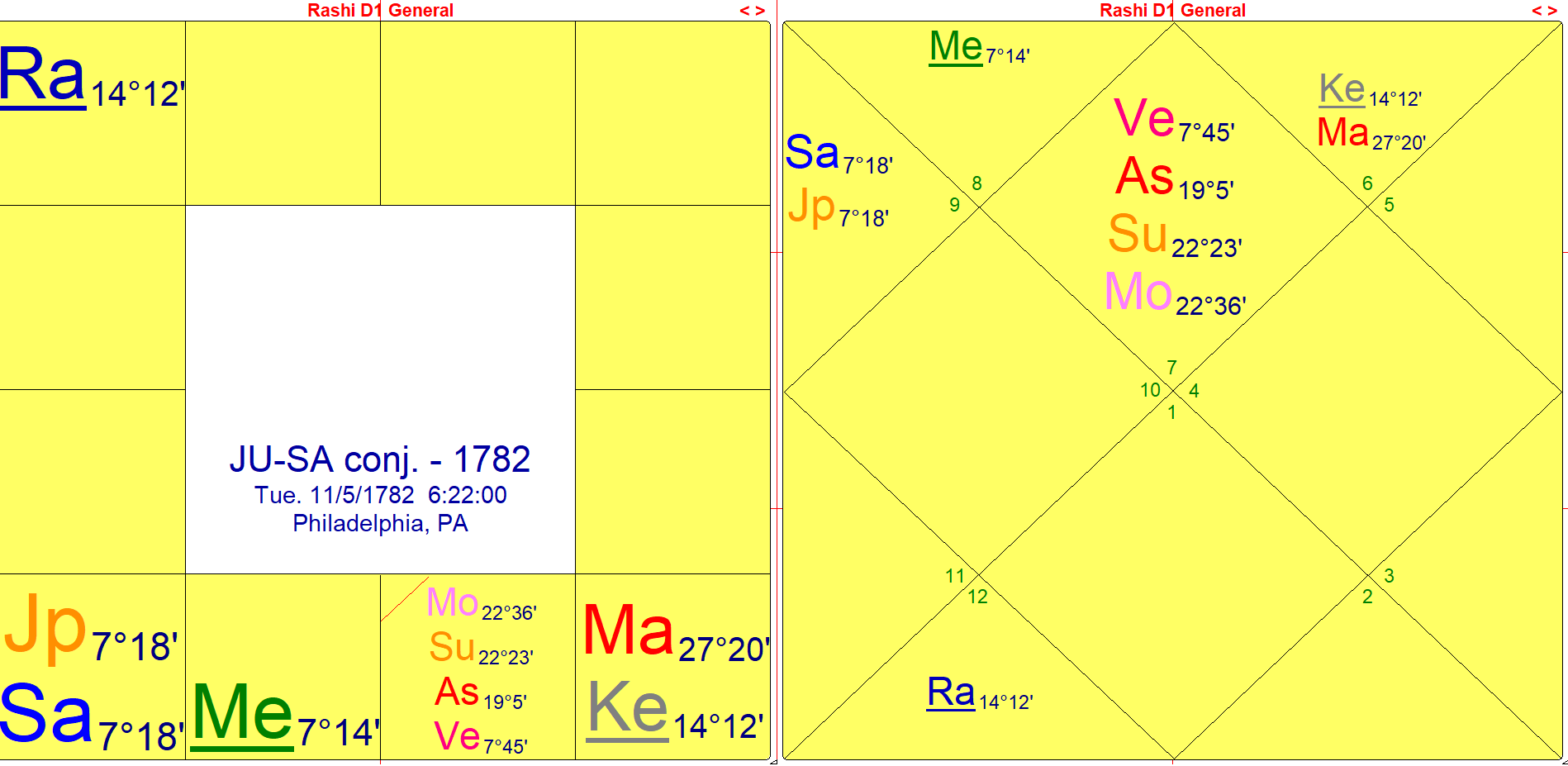
How to read a North and South Indian chart. All planets are in the sidereal zodiac (Lahiri ayanamsha). Underlined planets are retrograde.
The JU-SA conjunction Nov. 5, 1782: Notice the power of this chart even beyond the power of the conjunction itself, which is at the Galactic Center and is the first conjunction in the core FIRE period. The conjunction occurs just 22 minutes after the exact New Moon at 22:22 Libra in Jupiter-ruled Vishakha nakshatra. Not only is the JU-SA conjunction on the Galactic Center, but Venus is strong in its own sign of Libra and out of combustion range. Jupiter is strong in its own sign of Sagittarius, and Mars in Virgo is in mutual exchange with Mercury in Scorpio (a Parivartana yoga), bestowing forceful communications and language. Mars is Vargottama in Virgo (repeating in the same sign in various divisional charts), giving extra strength to this Mars. At 27:20 Virgo, Mars is just over 13 degrees beyond Ketu at 14:12 Virgo, and Mars conjoined with Ketu opposite Rahu expands the Mars energy, in this case – the physical (Mars) and communications (Mercury) energy, since Mars and Mercury are intertwined in a Parivartana yoga.
The calendar day was Tuesday, but the planetary day is still a Moon-ruled Monday, as it is shortly before sunrise. (The planetary day starts at sunrise.) Sun and Mars are the two fiery planets. Sun is debilitated but fortified by Venus in Libra; therefore a Neecha Bhanga Raja yoga. The Sun, or leader, national vitality, gains strength over time.
Of special note is the arc of the physical planets running in unbroken sequence from House 12 through House 3, and encompassing the Libra Ascendant. This is among the Nabhasa Aakriti yogas, specifically the Gada yoga, with all physical planets occupying four consecutive houses. Since the Ascendant is involved, in mundane astrology it gives strength to the national entity at this location . This chart signifies not only the end of the American War of Independence but it sets the tone for the entire 1782–1802 national consolidation cycle. The Gada yoga in the Nov. 1782 chart describes what an extreme initiative it took for the founding of the nation of the United State. It describes the rapid institutional consolidation, the upcoming aggressive expansion, the high resilience, aided by foreign alliances, and the ability to overcome obstacles decisively. It doesn’t prevent all trouble but does bring structural strength and forward momentum in that 20-year cycle.
Nor did the British Empire fall apart after losing the war against the American colonies. The JU-SA conjunction chart set for London, UK on Nov. 5, 1782 has an Ascendant at 11:14 Sagittarius, with the Jupiter-Saturn conjunction in the Ascendant of that chart. Jupiter is Digbala in the Ascendant (best possible angle of the chart), even though technically losing the Graha Yuddha to Saturn. The sweep of planets run from House 10 to the Ascendant (House 1), which is good. Mars is Digbala in the 10th house, giving an additional Digbala planet and a continued commanding position in the world. The British Empire was still dominant elsewhere in the world, and now turned its attention away from its former American colonies and towards European conflicts. However, Britain in the period from 1782 to 1802 Britain continued to challenge and pressure the young nation through frontier fort retention, support for native Indian resistance, naval interference, and treaty violations. These actions strained relations but were strategic, not colonial.
The Articles of Confederation were signed in Nov. 1777 and were replaced in March 1789 with the The United States Constitution we abide by today. It set up the type of government the nation would have. In 1789 the Electoral College unanimously voted for General George Washington to be the first U.S. President, and John Adams was elected as his Vice President. Washington served two terms – from April 30, 1789 to March 4, 1797. He declined to serve a third term. Though Philadelphia had served as the center of federal government for over 10 years, by 1800 the new buildings in Washington were ready and John Adams, our 2nd U.S. President moved into the White House Nov. 1, 1800, during his last year of his one term as President.
The USA Independence chart (July 4, 1776, 6:30 pm local time, Philadelphia, PA), not shown here, has an Ascendant of 8:59 Sagittarius, with four planets in Gemini in the 7th house: Mars, Venus, Jupiter, Sun. Sagittarius is ruled by Jupiter, which is strong in the 7th house aspecting the ascendant and its own sign and house. Also, the planetary day is Thursday, ruled by Jupiter. Moon is in Aquarius receiving Jupiter’s trinal aspect. Saturn is in Virgo at the top of the sky, so there are five planets in Dual signs, as well as a Dual sign Ascendant. This gives enormous flexibility and adaptability, with Sagittarius being the zodiacal sign most associated with the nation-state. Also, the USA Independence Ascendant is close to the Galactic Center, bestowing global prominence. The JU-SA conjunction in 1782 was also at the Galactic Center.
Jupiter’s planetary and sign dominance gives strength to the chart of a nation, and given that the nation was born of the JU-SA conjunction period of Pisces in 1762, and fully recognized as a sovereign state by the British government from Nov. 1782, on a preliminary basis, and then again in Feb. 1783 and in Sept. 1783, we get the full trajectory of the birthing period, even if the continent had already been settled by colonists from the early l600s onward, notably with the arrival of first English settlers at Jamestown (Virginia) in 1607, and at Plymouth (Massachusetts) in 1620. This would be echoed in the prominence of Massachusetts and Virginia in the official birthing of the nation 150+ years later, including with the first-ever U.S. President, a resident of Virginia, and his Vice President, a resident of Massachusetts – George Washington and John Adams, respectively.
*****
Note: For more material on the 20-year Jupiter-Saturn conjunction cycles as well as their larger cycles lasting 100s of years in one predominant element, please see the author’s book In Search of Destiny: Biography, History & Culture As Told Through Vedic Astrology, 2012. Chapter 1 contains 56 pp. on this topic: 1400 to 2400. It is also a component in many of her articles at this website.
Copyright © 2026 by Edith Hathaway. All rights reserved.