By Edith Hathaway © 2026
“He [Washington] was the highly favored instrument whose patriotism and name contributed greatly to the establishment of the independence of the United States.” Benjamin Rush
“He has so much martial dignity in his deportment that you [would] distinguish him to be a gentleman and a soldier among ten thousand people. There is not a king in Europe that would not look like a valet de chambre by his side.” Benjamin Rush
George Washington was a man of exceptional physical strength and fortitude. He was also mentally tough and courageous. Even his stature at 6’3” tall made him stand out among the men of his era. But he was also a very principled man gifted not only as an innovator in agriculture (a lesser known fact) but as a political and military leader. Most importantly, he understood that liberty was a gift from God and that he was fighting for a sacred cause, not for personal glory.
Without the leadership of George Washington and men of his caliber, the 13 American colonies might not have become one sovereign nation-state at all, or at the very least the British government might have retained control for many decades longer. Six months after the Declaration of Independence was signed, it was not clear at all who would win the war. At that point the British were winning and the Continental Army was in a state of collapse. But Washington well understood his role in birthing the nation, and he often cited the role of Providence in placing him in both military and political leadership positions. The Crossing of the Delaware on Christmas night 1776 was one such moment.
By June 1775, after the fighting at Lexington and Concord in April 1775 and the rapid mobilization of the New England militia, the Second Continental Congress moved to formalize the American resistance. On June 15, 1775, Congress unanimously voted to appoint George Washington Commander‑in‑Chief of the Continental Army, which Congress had created the previous day. He accepted the commission on June 16, 1775, and on July 3, 1775 he formally took command at Cambridge, Massachusetts.
Washington served as Commander‑in‑Chief of the Continental Army for 8 ½ years – from June 15, 1775 until his resignation on December 23, 1783, a few months after the signing of the Treaty of Paris on Sept. 3, 1783. After the war he returned to Mount Vernon, Virginia, where he spent six years as a private citizen, managing his estate, advancing agricultural innovation, promoting national unity, leading the Potomac navigation project, and presiding over the Constitutional Convention. Then in 1789 he was unanimously elected President by the Electoral College. He served two terms in office, from April 30, 1789, the day of his first inauguration, to March 4, 1797. He declined a 3rd term and retired from the presidency in spring 1797. Well over 200 years since he left office he is still considered America’s greatest president.
Early Childhood & Years as a Land Surveyor of the Virginia Frontier
After the death of his father in April 1743 when Washington was age 11, his prospects ended for a university education in Europe like his older half-brothers. His early education instead was mostly practical rather than classical, with a focus on mathematics, surveying, geography, and the kind of applied skills suited to the career path his half brother Lawrence and the Fairfax family helped set him on. (Lawrence married Anne Fairfax in 1743.) Because of George’s close association with the Fairfax family and Lord Thomas Fairfax’s ownership of over 5 million acres of land in Virginia, he soon had the opportunity to learn land surveying through an apprenticeship starting in March 1748 (at age 16). By July 1749 he had his official surveyor’s license.
His career trajectory might have stayed focused entirely on land surveying and farming, but his half-brother Lawrence Washington was an important mentor and a strong influence to go in the direction of a military and political career. He was a soldier, planter, politician, and landowner in colonial Virginia.
Military Career Interspersed with Life as a Farmer
George went off to fight in the French and Indian Wars (1754-1763), though he served only in the first phase of those wars involving the Virginia frontier, from spring 1754 to Nov. 1758. During that time he was appointed Aide-de-camp to British General Braddock and gained fame for how he handled various military campaigns, notably the retreat at the Battle of the Monongahela (July 9, 1755).
After resigning from the military in Nov. 1758, George returned to Mount Vernon to marry Martha Custis in Jan. 1759 and manage his Mount Vernon estate. He had inherited it outright in 1754, after being second in line to inherit the property from his half-brother Lawrence, who died in July 1752. Martha was recently widowed, with 2 surviving children (2 others died in infancy). Together with his own inheritance plus her considerable wealth from her late husband, George was able to expand Mount Vernon from 1200 to 8000 acres, most of it by 1760, with one last parcel by 1786. He also managed the Custis estate belonging to his wife.
Washington was innovative as a farmer throughout his life. He began modernizing Mount Vernon soon after his marriage in Jan. 1759, shifting from tobacco to wheat, experimenting with crop rotation, testing fertilizers, and expanding the estate. Tobacco exhausted the soil and also made Virginia planters dangerously dependent on British/European markets. Washington abandoned tobacco in the 1760s and was among the first planters in Virginia to do so. It was a very important decision, a bold economic move, and one he wrote about a lot.
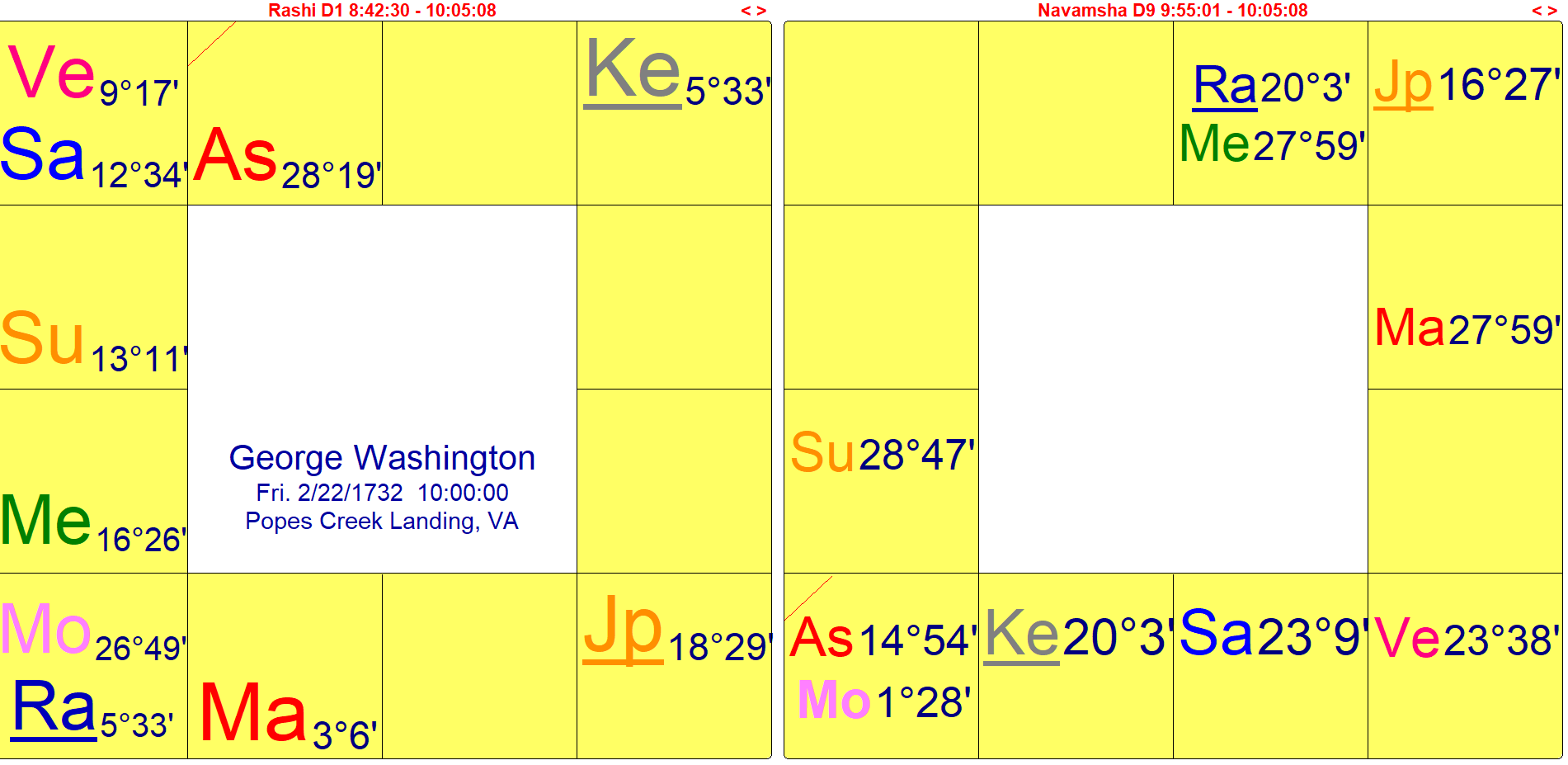
How to read a North and South Indian chart. All planets are in the sidereal zodiac (Lahiri ayanamsha). Underlined planets are retrograde.
FIRST U.S. President, FIRST Commander-in-Chief, FIRST most influential planter to abandon tobacco
The destiny to go first, to pioneer a movement – or in this case a nation, and the fight to make it happen, astrologically that requires a strong Sun and Mars and very often a strong Aries component, Aries being the first sign in the zodiac. The FIRE signs signify movement, Aries being a Chara (active, cardinal) sign – to initiate the action, Leo as a Fixed sign – to stabilize the action, and Sagittarius, a Dual sign – to make adjustments and have versatility and flexibility in executing all the actions. Ascendant lord Mars is very powerful here in its own sign of Scorpio (a Fixed WATER sign) in the 8th house. All three qualities are represented here, with Mars bestowing both passion and stamina.
George Washington has an Aries Ascendant, at 28:19 Aries, in Krittika nakshatra, with natal Moon and Rahu in Sagittarius, two of the FIRE signs. Krittika nakshatra is ruled by Agni, the god of FIRE and the purifier. He has two heads, lives in heaven and on earth, and is considered the mediator between men and gods. The person with Krittika prominent in the chart is likely to be bold, courageous and fiery. Washington had all these components, except his demeanor was modest, not fiery or combative. He was self‑confident and well‑spoken, but exercising self-restraint, not given to boasting. His contemporaries described him as calm in the face of provocation, a man of few words but decisive action. He avoided confrontation, and in battle he understood when it was prudent to retreat at the right moment, a rare quality among 18th century commanders. For this he was both praised and mocked. Many of his contemporaries viewed retreat as dishonorable, but it turned out to be crucial in dealing with the British armies, who were victorious initially, but not over the long haul – fighting far from their home country and their supply lines.
This quality of self-restraint is shown by the aspect (influence) of Saturn on his Moon in both the birth and Navamsha charts. The Moon is the workings of the mind and consciousness. Saturn-Moon in both charts confirms the influence and brings the weight of worldly responsibilities. It does not decrease or disappear. The Moon is also Vargottama in Sagittarius (repeating in the same sign in the Navamsha and other divisional charts). A Vargottama planet gains strength, and Sagittarius is the sign most closely associated with patriotism and national pride.
Though you might expect a more outward display of enthusiasm, with Navamsha Moon opposite Jupiter, it is counterbalanced by the Saturn-Moon effect and the Navamsha Moon hemmed in by classic malefic planets (Sun and Ketu): a Papa Kartari yoga. This can bring restraint until one is forced to extricate oneself from difficult circumstances or surroundings. Throughout the American Revolutionary Wars, as Commander-in-Chief of the Continental Army General Washington was forced to exercise restraint, and to focus on preserving his troops against the onslaught of British troops in superior numbers using often superior weapons.
Washington learned to use his Saturn-Moon very effectively, giving him the mental and physical discipline to deal with the vast physical energy he possessed and which we will discuss shortly. But in a lesser person it could have weighed him down overmuch. Moon is also on the eclipse axis, conjunct Rahu opposite Ketu, although within 21° orb. Moon-Rahu can be destabilizing emotionally. His relationship with his mother, Mary Ball Washington (also the Moon) was fractious at times and became increasingly strained as he grew into adulthood. She was very demanding and disapproved of his military career, despite how he clearly distinguished himself in that arena. After his father’s death he grew closer to his half-brother Lawrence and his extended family, especially the Fairfax family.
Spotless reputation & the profile of an entrepreneur
With this combination of qualities for both the ability to take action as well the ability to be circumspect in the actions he took, the astrological factor that supports his ongoing excellent reputation, despite the inevitable detractors, is the Amala yoga. (Amala means “spotless”). According to classic texts this yoga gives name and fame for as long as the Moon and the stars endure. Amala yoga occurs when a classic benefic planet is situated in the 10th house from the Ascendant or the Moon, and is unafflicted by malefic association or aspect. George Washington has this from both the Ascendant and the Moon, and in both the birth chart and the Navamsha chart! This is quite rare. No wonder he is still considered the best U.S. President over 200 years later!
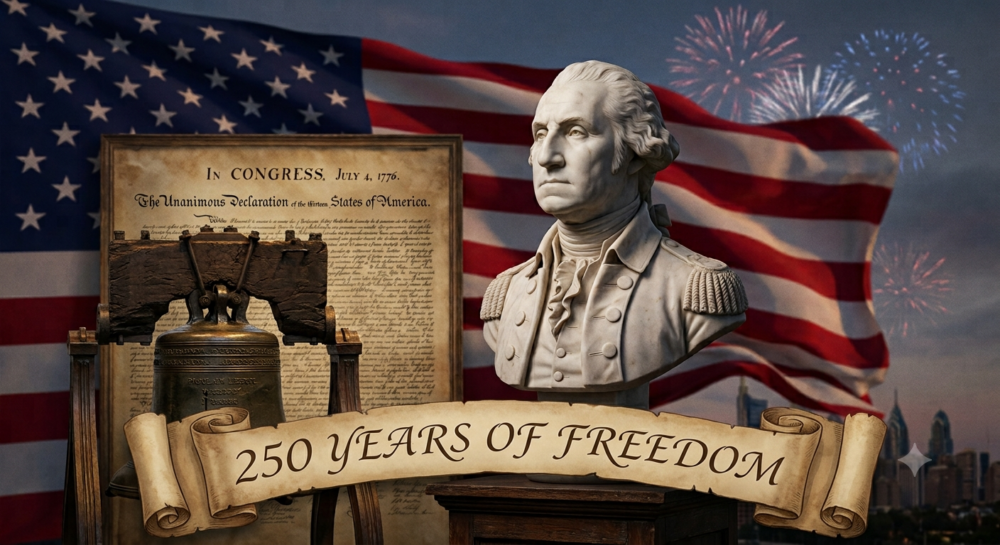
In the birth chart Mercury is in the 10th house from the Ascendant, while Jupiter is in the 10th house from the Moon. In the Navamsha chart Venus is in the 10th house from both the Ascendant and the Moon. Venus is debilitated in Virgo, which would ordinarily detract, but it is corrected by two factors: 1) Venus in Virgo is in mutual exchange with Mercury in Taurus (a Parivartana yoga), and 2) Jupiter (lord of Venus’s sign of exaltation in Pisces) is in an angular house from the Moon. The Mercury-Venus interchange gives him a gift for diplomacy while the Amala yoga keeps him in a positive light for the long-term, despite some political and military enemies who were jealous of his position and felt they were more deserving. The Amala yoga favored him for the long haul, and we celebrate him and the other Founding Fathers at this occasion of the 250th anniversary of the Founding of the United States.
His abilities as an entrepreneur revealed themselves notably at his own estate at Mount Vernon, with his numerous innovations in agriculture, but also as military and political leader – being willing and unafraid to try new techniques if they brought an obviously positive and effective result, regardless of previous tradition or protocol. The signature for the entrepreneur can be seen astrologically by the Jupiter-Saturn opposition. Jupiter at 18:29 Virgo opposes Saturn at 12:34 Pisces. On Oct. 22, 1731, four months prior to his birth, there was an exact JU-SA opposition at 8:20 Virgo-Pisces. (In our current era the trillionaire, super-entrepreneur Elon Musk was born June 28, 1971 with a JU-SA opposition, Jupiter at 4:11 Scorpio, Saturn at 7:39 Taurus.)
Extraordinary physical strength and stamina/extraordinary possibilities for wealth and inheritance
Astrologically George Washington’s physical strength can be attributed to an Aries Ascendant and a phenomenally powerful Mars, which is also his Ascendant lord. The Ascendant lord unafflicted in the 8th house gives strong physical vitality, business success, and financial gains from inheritance and from the spouse. George had all of these. Inheritance came initially though his half-brother in July 1752, and later through his wife Martha in Jan. 1760. Mars = siblings, most especially brothers, being a masculine planet. In the Navamsha chart Mars repeats in the 8th house, though Navamsha Mars is not Ascendant lord but gains strength through two factors: 1) Neecha Bhanga Raja yoga: Mars is debilitated in Cancer, but corrected by Moon in the Ascendant; 2) Viparita Vimala Raja yoga: 12th lord Mars is situated in the 8th house. This yoga also serves to prevent financial losses.
Further, there are additional Dhana yogas of wealth, primarily the Adhi yogas, with natural benefics situated in Houses 6, 7, or 8 from the Moon or Ascendant. One of these occurs in the birth chart and two in the Navamsha chart.
Mars also rules over blood, and at his death doctors bled some five units of blood out of his body, i.e. half the volume of blood in his body, which weakened him enormously and may have caused his death, if not hastened it.
Societal connections and the propensity to spread one’s influence
The condition of the Sun and Moon are extremely important for social connections and stability of body and mind, respectively. Except for being on the eclipse axis in the birth chart, which can bring some emotional upheavals and unpredictability, natal Moon is well situated in the 9th house of good fortune. This is interesting considering that even though Moon as 4th lord of education brought an abrupt end to possibilities of being educated in Europe in his Moon-Saturn period, George probably fared better overall by remaining in Virginia and gaining the practical, though non-classical education he received through his half-brother Lawrence and the Fairfax family.
Navamsha Moon is also very well placed in the Navamsha Ascendant, receiving aspects from both the Dharma and Karma planets – Jupiter and Saturn, respectively. Navamsha Moon is only hampered by the Papa Kartari yoga to the Ascendant and Moon, but that is countered by other factors, notably a strong Venus and Jupiter in the angles, with Mercury and Venus in mutual exchange (Parivartana yoga). In the birth chart Venus is exalted in Pisces in the 4th house (of home, family, and real estate) from the Moon. This is also another Dhana yoga of wealth, with Venus and Saturn (11th and 2nd house lords, respectively) in the 4th house.
In the birth chart the Sun is well placed in the 11th house from the Ascendant and 3rd house from the Moon. Sun is also protected by a Shubha Kartari yoga, with classic benefic planets on either side (Mercury and exalted Venus). In the Navamsha chart Sun serves as another Dhana yoga of wealth, as 9th lord in the 2nd house of income.
Notably, both natal Sun and Moon are surrounded by planets in houses either side. With the Moon, this is a Durudhara yoga. With the Sun, this is a Ubhayachari yoga. These yogas give excellent social connections, as one is never separated from people in time of need, and there is always a way to meet the right people at the right time. The Durudhara yoga gives many associations, with many benefits from them. The Ubhayachari yoga confers on the native a large network of friends and supporters. George has both of these yogas that are favorable for social connections.
To cap it off, he has the Daama yoga (Daama = wreath), in which the physical planets are spread out over six houses. It bestows wealth, happiness from children, being learned, generous, and contented. George and Martha raised her two younger children (two other children died in infancy), and when Lawrence Washington died they raised two of their children, as well as giving guidance and/or financial support to many other friends and family members. George was most likely rendered infertile by his bout with small pox at age 19, as well as dysentery in late 1758 (age 26). With exalted Venus in his 12th house, intimacy was not likely to be an issue. This was a happy marriage.
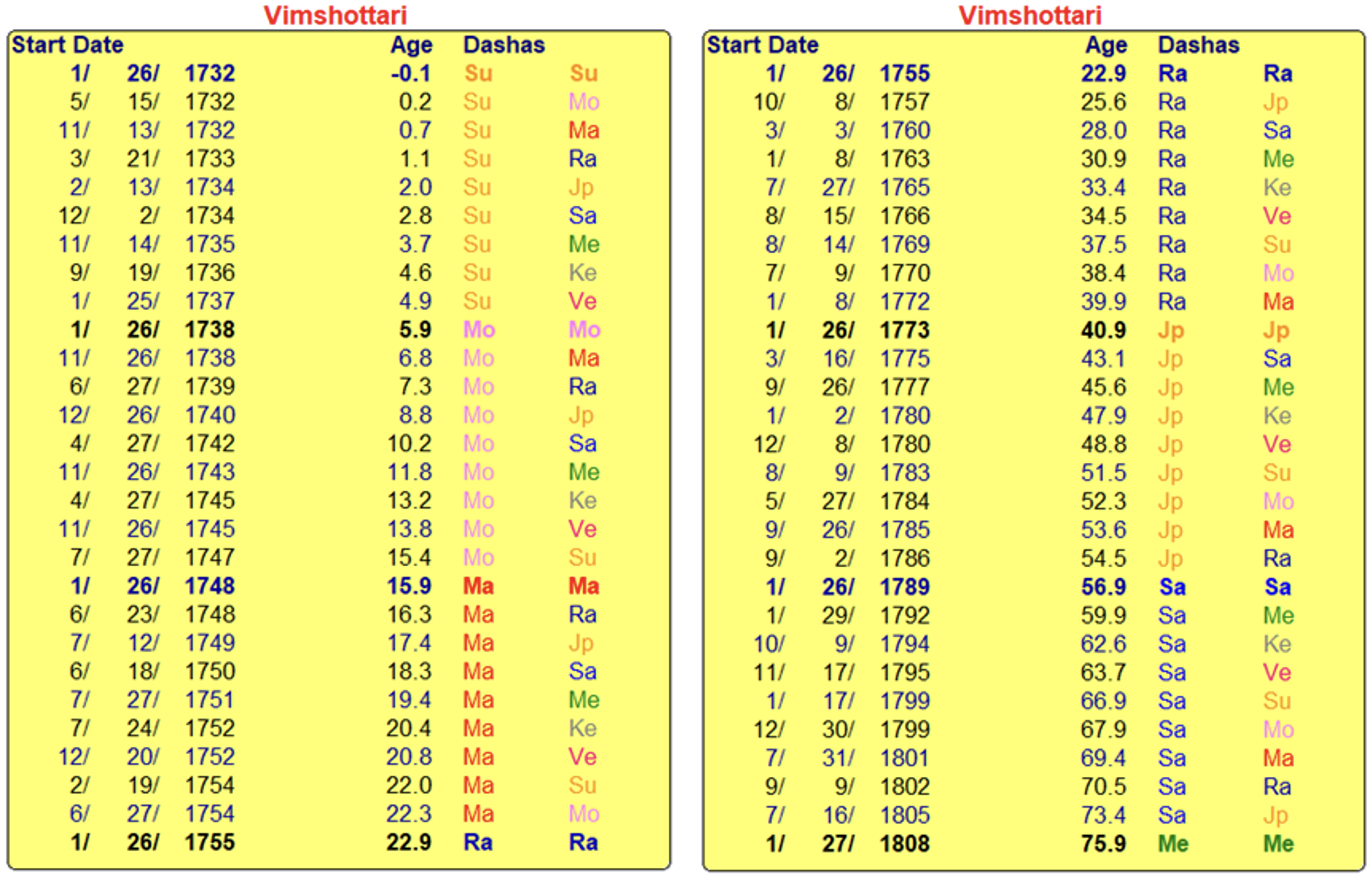
IMPORTANT DATES & LIFE EVENTS
April 12, 1743: George’s father Augustine Washington dies suddenly at age 48, ending any possibility of a higher education in Europe for George, who is now left under the guidance of half-brother Lawrence Washington and the Fairfax family (Lawrence’s in-laws). MOON-SATURN period starts April 27, 1742. (See the discussion above about Moon-Saturn in George’s chart, repeated in several charts.)
March 1748: At age 16 George starts an apprenticeship to learn land surveying with the prominent Fairfax family. Lord Thomas Fairfax owns over 5 million acres of land in Virginia. The 7-year MARS DASHA starts Jan. 26, 1748.
July 26, 1752: Lawrence Washington dies, naming George Washington 2nd in line to inherit Mount Vernon. MARS-KETU starts July 24, 1752. (Natal Ketu is in House 8 from natal Mars, but also Asc. lord and 8th lord in the 8th house both are significators for financial gains or inheritance. Mars = siblings.)
Jan. 9, 1759: George marries Martha Custis. RAHU-JUPITER starts Oct. 8, 1757. (Navamsha Jupiter is in the 7th house of marriage opposite Navamsha Moon, activating the Lagnadhi yoga of wealth.) George expands Mount Vernon from 1200 acres to 8000 acres, most of it by 1760.
June 15, 1775: George is appointed Commander-in-Chief of the Continental Army. JUPITER-SATURN period starts March 16, 1775. (The JU-SA opposition indicates the entrepreneur, the ability to take charge of large endeavors. Natal Jupiter aspects his 10th house of status and career.)
April 30, 1789: George begins his first term as U.S. President. He serves two terms, ending March 4, 1797. The 19-year SATURN Dasha starts Jan. 26, 1789. (The Electoral College votes on Feb. 4, 1789 to elect Washington as first U.S. President. It was unanimous, with all 69 votes going to Washington.)
Dec. 14, 1799: George dies. SATURN-SUN period starts Jan. 17, 1799. (He dies two weeks before the start of SATURN-MOON period. Natal Sun is in Saturn’s sign in both birth chart and Navamsha chart. Sun and Saturn are planetary enemies, so this period could bring physical vulnerabilities through overwork or cold, both of which are involved here. While attending to the affairs of his estate, he neglected his own health. In trying to help, the doctors only weakened him, hastening his death.
The death of George Washington
Washington’s work ethic and physical stamina remained extraordinary throughout his life. On December 12, 1799, he spent hours riding in freezing rain and snow while inspecting his farms. He returned home soaked, but continued working without changing clothes. The exposure triggered a sudden bacterial infection, now understood as acute epiglottitis, which caused rapid swelling of the epiglottis and severe airway obstruction. He fell ill late on December 13 and died about 20 hours later, on December 14. His doctors removed about five units of blood, roughly 40–45% of his blood through aggressive bloodletting — a common medical practice at the time. This almost certainly hastened his death.
The most important military and political decisions of George Washington
In the upcoming list, note how his most important military decisions were made in his Jupiter-Saturn period, activating the JU-SA opposition in Washington’s birth chart. This planetary combination denotes the entrepreneur and the courage and ability to make strategic decisions that could have major effects on large groups of people. The Dasha and its sub-periods activate the planetary combinations in the birth chart and/or Navamsha chart and give the dates during which they are likely to bestow their karmic fruits, for good or for ill. His natal Jupiter is in Virgo, Saturn in Pisces. Adding another confluence, transiting Saturn was in sidereal Virgo July 1, 1774 to Sept. 18, 1776, conjoining Washington’s JU-SA opposition axis.
In the larger picture, Washington’s entire military career spanned either the 18-year Rahu Dasha (the French and Indian Wars), or the 16-year Jupiter Dasha (the American Revolutionary War). He was Commander-in-chief of the Continental Army entirely during his Jupiter Dasha, from Jan. 26, 1773.
Saturn Dasha began Jan. 26, 1789, and within nine days (Feb. 4, 1789) Washington was unanimously elected as first U.S. President. Saturn rules his 10th house of status and career, and from Saturn in Pisces in the birth chart (i.e. Dasha Lagna), Moon is in the 10th house of status and career, typically an excellent placement for a politician. Rahu is also good in the 10th house, though disturbing to the Moon. Saturn is also strong in the Navamsha chart, exalted in Libra, with sign lord Venus in a Neecha Bhanga Raja yoga, i.e. debilitated, but corrected and gaining increasing strength over time. In any case, his Amala yogas and various other factors discussed earlier are going to keep placing Washington in positions of maximum exposure and status.
Military decisions
The smallpox inoculation order in Feb. 1777 was rare, bold, and historically significant. It was the first mass immunization policy in American history, and few military leaders anywhere in the world had ever taken this step. It was of crucial importance, given how close smallpox came to crippling the Continental army’s manpower entirely. Having contracted smallpox at age 19, George was already innoculated. JUPITER-SATURN period March 16, 1775 to Sept. 26, 1777
The Christmas night crossing of the Delaware in 1776 was monumental because the American Revolution was on the brink of collapse. Washington’s army was shrinking, morale was shattered, enlistments were about to expire, and British forces controlled New York and New Jersey. By launching a daring nighttime attack across an ice‑choked river in a blizzard, Washington won a stunning victory at Trenton that revived morale, saved the Continental Army from disintegration, and kept the Revolution alive. Without Washington’s action, the American cause might well have ended in December 1776.
His adoption of a Fabian strategy through much of the war, deliberately avoiding large, decisive battles against a better-trained, better-supplied British army, frustrated many of his own officers and members of Congress who wanted more aggressive action. But Washington understood that simply keeping the Continental Army intact as a fighting force, rather than risking annihilation in open battle, was itself a form of victory, since the British strategy depended on crushing American resistance outright.
The decision to retreat from New York in late Aug. 1776 after the disastrous Battle of Long Island , rather than allow his army to be encircled and destroyed by Howe’s forces. This preserved the army at a moment when its loss would have likely ended the war.
Recognition of the need for French support and pursuit of the alliance. This materialized after the Battle of Saratoga. He then coordinated with Rochambeau and the French fleet for the Yorktown campaign in 1781. It showed a willingness to subordinate personal command instincts to a broader strategic partnership that ultimately won the war.
*******
We have already noted that Washington’s Moon-Saturn contacts give him a tendency for self-discipline, but also self-restraint, and that his political career began exactly with his Saturn Dasha.
What ties a lot of these items below together is a recurring pattern: Washington was repeatedly handed opportunities to seize or expand his personal power, and he repeatedly declined them. That restraint, as much as any battlefield tactic, is probably his most distinctive legacy.
Political decisions
Voluntarily resigning his military commission in Dec. 1783, rather than retaining power or accepting calls from some officers to install himself as a military strongman. This stunned contemporaries and set a precedent for civilian control over the military that shaped the entire American political tradition.
His handling of the Newburgh Conspiracy in March 1783. Frustrated officers considered a potential mutiny or coup over unpaid wages and pensions. Washington defused the situation in person, partly through a now-famous moment where he paused his speech, put on reading glasses he rarely wore in public, and remarked that he had grown gray in service to his country and now found himself going blind as well. The gesture reportedly moved officers to tears and dissolved the conspiracy.
Stepping down after two terms as president in 1796, rather than serving for life. He established the two-term norm that held (with the single exception of FDR) until it was codified by constitutional amendment in 1951.
His Farewell Address in 1796 warned against the dangers of permanent foreign alliances and the rise of divisive political factions, concerns that still get cited in American political discourse today.
Choosing a strong, broadly capable cabinet as president, including figures with sharply opposing views like Alexander Hamilton and Thomas Jefferson. Generally he tried to mediate between them rather than govern as a partisan figure, reflecting his instinct to keep the young republic from fracturing along ideological lines too early.
His decision to personally lead troops in suppressing the Whiskey Rebellion in 1794 demonstrated that the new federal government could and would enforce its laws, without him turning that show of force into anything resembling tyranny. Washington led a force of 13,000 militia. The Whiskey Rebellion threatened the validity of the Constitution itself. In previous years Shay’s Rebellion (1786-87) threatened the Articles of Confederation and led directly to the creation of the U.S. Constitution. However, the Whiskey Rebellion was more dangerous to the new federal government.
*******
Copyright © 2026 by Edith Hathaway. All rights reserved.